


The problem is not always poor blade quality. Very often, it is a mismatch between blade and material.Woodworking is not one single application. Hardwood, softwood, MDF, plywood, melamine board, veneered panels, and composite materials differ in density, resin content, surface layer, fiber direction, and abrasiveness. Professional saw blade selection should not start with the broad word "wood." It should start with material structure, cutting direction, and required edge quality.
First ask: are you ripping or finishing?
Many blade selection mistakes happen because the cutting task is not clearly defined.For ripping, rough cutting, framing lumber, and fast sizing, efficiency, chip removal, and lower machine load matter more. These jobs do not always need a high tooth count. Larger gullets and fewer teeth can help remove chips faster.
For crosscutting, trimming, sizing, and visible-edge cutting, clean edges and reduced tear-out matter more. A higher tooth count and suitable ATB or fine-finish geometry are often more useful than pure speed.For MDF, melamine, veneered panels, or composite materials, the challenge is not just wood fiber. Resin layers, brittle surface layers, dust, plastic content, and abrasion all need attention. Tooth geometry, coating, grinding quality, and blade body stability must work together.
Hardwood: more teeth is not always better
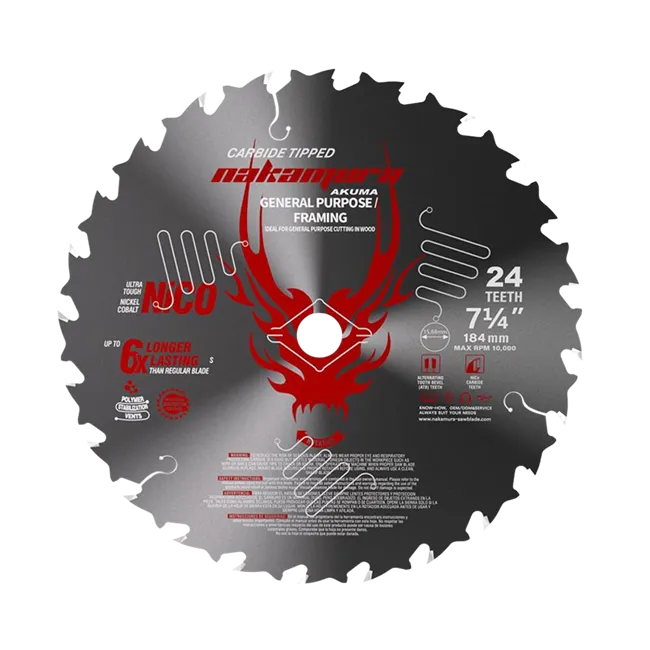
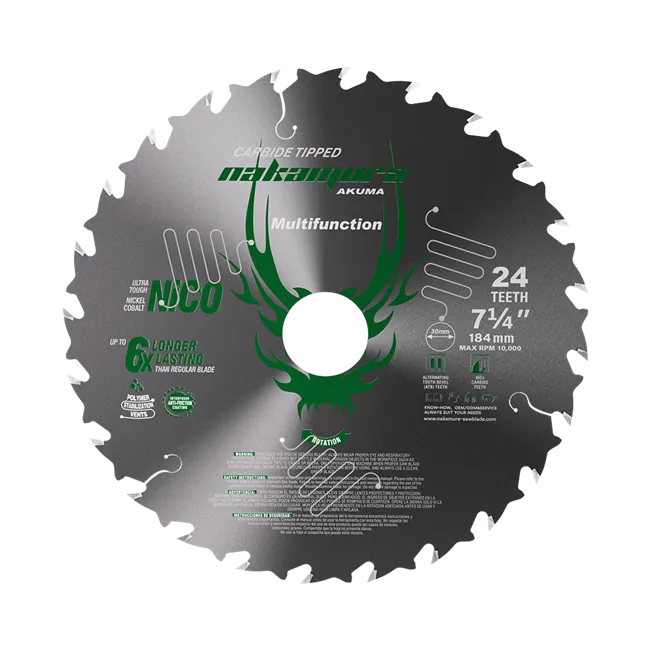
Hardwood has higher density and cutting resistance. Many users assume that hardwood always needs a high tooth count, but this is not always true.For ripping oak, walnut, beech, maple, and other hardwoods along the grain, a low-to-medium tooth count TCT blade can be more suitable because it clears chips more easily and cuts with less resistance. Using too many teeth for thick ripping may increase heat, pushing force, burning, and slow cutting.The Nakamura Woodworking 24 Tooth TCT Blade is specified as 184mm1.51.015.8824T and is designed for thick timber, framing lumber, OSB, MDF, laminated wood, softwood, and hardwood ripping. It is more suitable for woodworking users who need cutting efficiency, easy entry, and jobsite versatility.
For hardwood crosscuts, end cuts, or visible furniture surfaces, a higher tooth count and finer edge geometry may be more suitable. In other words, even for the same hardwood, ripping and crosscutting may require different blades.

Panels: reduce chipping and burrs
MDF, plywood, particleboard, melamine board, and veneered panels are all woodworking materials, but they do not cut like solid wood.
These materials often contain more resin, brittle surfaces, and dense engineered cores. Cutting problems include top and bottom chipping, burrs, surface tear-out, and dust build-up. For melamine and decorative panels, edge quality is often the first thing customers notice.
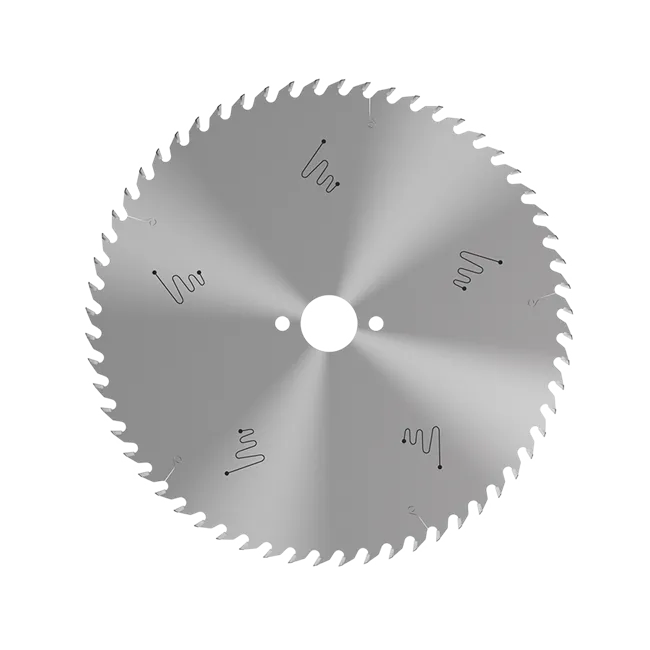
The Nakamura Chip-Free Circular Saw Blades For Melamine use a 184mm 60T specification with ATB(BC) teeth. The product page lists applications including wood, OSB, MDF, integrated wood, and melamine. For cabinet panels, desks, shelves, and small furniture panel processing, this type of fine-tooth blade is better suited to controlling surface chipping and cut quality.However, clean panel cutting does not depend on the blade alone. Machine guide accuracy, clamping, feed speed, blade projection height, backing boards, and scoring methods can all affect the final result.
Composite materials: wear resistance, chip removal and heat control
Composite materials are increasingly common in woodworking shops. Examples include composite decking, wood-plastic boards, engineered wood, film-faced boards, and panels containing plastic or adhesive layers. These materials combine wood fiber with plastic, bonding agents, or wear-resistant components.
If the tooth design is not suitable, plastic content may become sticky due to heat, the surface may chip, and residue may build up between the teeth. A standard wood blade may cut through the material, but it may not provide stable long-term performance.The Nakamura Composite Decking Round Saw Blades are listed as 190mm1.51.02050P, with ATB(R) teeth, a 65Mn body, and Teflon coating. The product page explains that composite decking contains wood fibers, plastic, and bonding agents, and that cutting these materials can involve melting, chipping, and faster blade dulling if the wrong blade is used.Therefore, composite materials should not simply follow solid wood blade logic. A better approach is to select suitable tooth geometry, wear-resistant tips, anti-stick coating, and correct RPM and feed speed.

Tooth geometry: do not mix up ATB, TCG and FTG
Common woodworking tooth geometries include FTG, ATB, ATB+R, and TCG.
- FTG, or Flat Top Grind, cuts directly and clears chips efficiently. It is more suitable for ripping and fast material removal, but it usually does not give the finest surface.
ATB, or Alternate Top Bevel, uses alternating left and right bevels to slice wood fibers. It is suitable for solid wood crosscuts, plywood, and veneered panels where tear-out control matters. It is not mainly about reducing chip splash. It is about cutting fibers cleanly before the next tooth removes the chip.
- TCG, or Triple Chip Grind, uses a chamfered tooth followed by a lower flat tooth. It is commonly used for melamine, laminates, plastics, non-ferrous metals, and some abrasive composite materials. It offers stronger edge durability, but it is not the only answer for hardwood finishing.
So it is too simple to say "hardwood uses TCG and panels also use TCG." Real selection depends on material, cutting direction, machine type, and edge requirement.
Hook angle: more complex than positive for softwood and negative for hard materials
Hook angle affects how aggressively a blade enters the material. A positive hook angle can feel faster and more aggressive, but if the machine is not well controlled, it may create a pulling feeling. A negative or low hook angle gives a smoother, more controlled entry and is often used on miter saws, aluminum blades, laminated materials, or applications where cutting control is important.
- For woodworking shops, hook angle should not be selected only by material hardness. Machine type matters.
- Handheld circular saws and table saws often need a balance between cutting efficiency and control.
- Miter saws need stable entry and reduced grabbing.
- Panel finishing requires lower chipping and better edge quality.
- Composite materials require control of heat, chip sticking, and tool wear.
Correct hook angle design means matching blade, machine, and material, not using one rule for every job.

Nakamura's woodworking blade selection logic
Nakamura's woodworking blade solution is not about using one blade for every material. It is about matching the blade to the application.
For thick timber, framing lumber, softwood, and hardwood ripping, 24T or medium-low tooth count TCT blades can be selected for efficiency, chip removal, and lower machine load.For MDF, melamine, plywood, veneered panels, and furniture boards, higher tooth count fine-finish blades are more suitable for controlling chipping, burrs, and surface quality.For composite decking, wood-plastic materials, film-faced boards, or more abrasive composite panels, blades designed for composite materials are more suitable. If production volume and material abrasiveness are high, PCD options may also be evaluated.
This application-based approach helps woodworking shops reduce hidden costs.
Conclusion
There is no universal woodworking blade that fits every material perfectly.Hardwood selection depends on whether the cut is ripping or finishing. Panel cutting focuses on chipping, resin, and surface quality. Composite cutting must consider plastic content, adhesive, dust, and heat control. The right blade selection comes from matching material, machine, tooth geometry, tooth count, hook angle, and production volume.Nakamura - matching every wood and panel material with a more suitable saw blade.