

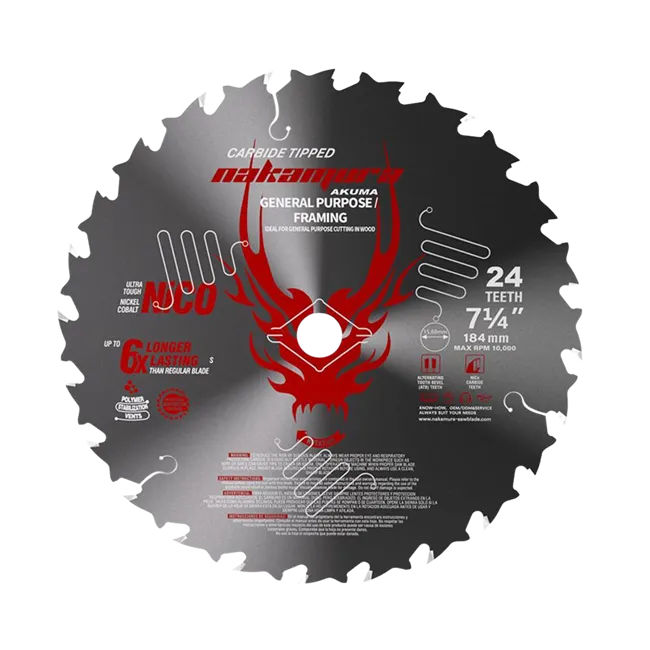
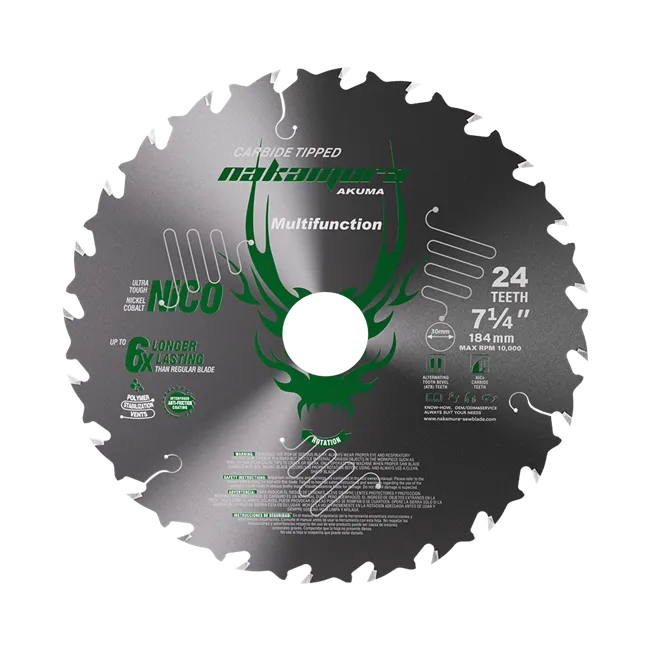

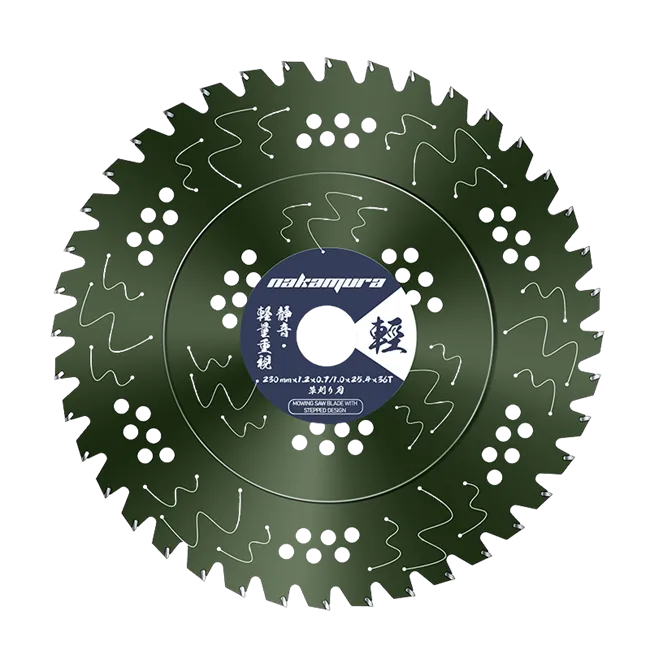

Brand: Nakamura
Tooth Tipped: Ceremt/Carbide Tooth Tipped
Diameter: 255mm*2.0*1.6*25.4*48T
Teeth Type: BT Teeth
Application: Angle Steel, Spiral Steel Pipe, Round Pipe,...
Metal Circular Saw Blade
-
![Cold Cut Metal Saw Blade]()
-
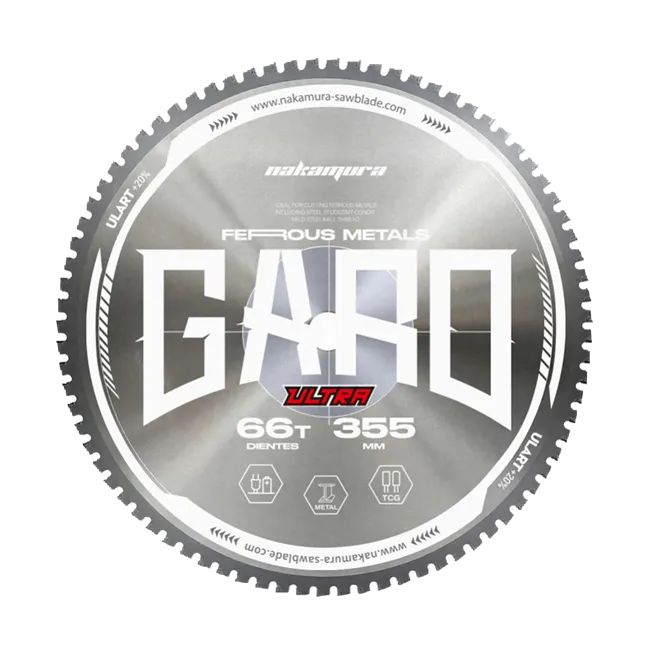
![355mm Carbide Saw Blade For Metal]() 355mm Carbide Saw Blade For MetalBore Size: 25.4mmread more
355mm Carbide Saw Blade For MetalBore Size: 25.4mmread more
Diameter: 355mm*80T
Teeth Type: BT Teeth
Material of Blade Body : 75Cr1
Application: Angle Steel, Spiral Steel Pipe, Round Pipe, etc -
![148mm Circular Metal Saw Blade]() 148mm Circular Metal Saw BladeDiameter: 148mm*40Tread more
148mm Circular Metal Saw BladeDiameter: 148mm*40Tread more
Teeth Type: BT Teeth
Material of Blade Body : 75Cr1
OEM/ODM: Support
Application: Angle Steel, Spiral Steel Pipe, Round Pipe, etc -
![Non Ferrous Metal Cutting Blade]() Non Ferrous Metal Cutting BladeSeris: GARO Metal Seriesread more
Non Ferrous Metal Cutting BladeSeris: GARO Metal Seriesread more
Diameter: 255mm*2.0*1.6*25.4*48P
Teeth Type: BT Teeth
Material of Blade Body : 65Mn/75Cr1
Application: Angle Steel, Spiral Steel Pipe, Round Pipe, etc -
![Metal Cutting Circular Blade]() Metal Cutting Circular BladeNakamura Garo Series saw blades introducing exclusive innovation for cutting metals and stainless steels with a cordless or corded circular saw. The specially Sandvik cermet teeth provide high...read more
Metal Cutting Circular BladeNakamura Garo Series saw blades introducing exclusive innovation for cutting metals and stainless steels with a cordless or corded circular saw. The specially Sandvik cermet teeth provide high...read more -
![Cermet Tipped Saw Blades Metal Cutting]() Cermet Tipped Saw Blades Metal CuttingBest Selling Upgrades GARO+Cermet Metalread more
Cermet Tipped Saw Blades Metal CuttingBest Selling Upgrades GARO+Cermet Metalread more
Iron Blade Upgrade - Ceramic Tipped lron Blade
Material of Blade Body : 75Cr1
OEM/ODM: Support
Teeth Type: BT Teeth... -
![Ultra-Quiet Metal Cutting Blade For Radial Arm Saw]() Ultra-Quiet Metal Cutting Blade For Radial Arm SawUpgrade to our ultra-quiet cermet tipped saw blades. Enjoy safe, spark-free cold cutting, zero wobble precision, and smooth, burr-free edges for all your metalwork.read more
Ultra-Quiet Metal Cutting Blade For Radial Arm SawUpgrade to our ultra-quiet cermet tipped saw blades. Enjoy safe, spark-free cold cutting, zero wobble precision, and smooth, burr-free edges for all your metalwork.read more
Diameter:... -
![12 Inch Metal Cutting Circular Saw Blade]() 12 Inch Metal Cutting Circular Saw BladeThis circular saw blade cuts quickly and can quickly process even the toughest metal materials. In addition, the precision design ensures a clean and accurate cut every time, minimizing the need...read more
12 Inch Metal Cutting Circular Saw BladeThis circular saw blade cuts quickly and can quickly process even the toughest metal materials. In addition, the precision design ensures a clean and accurate cut every time, minimizing the need...read more -
![Silent Cermet Metal Chop Saw Blades]() Silent Cermet Metal Chop Saw BladesCermet Tipped Saw Bladesare laser cut and offer superior wear and heat resistance for long cutting life in heavy duty applications. These blades feature a super-thin kerf for fast, efficient...read more
Silent Cermet Metal Chop Saw BladesCermet Tipped Saw Bladesare laser cut and offer superior wear and heat resistance for long cutting life in heavy duty applications. These blades feature a super-thin kerf for fast, efficient...read more


Company Profile
We mainly produce carbide saws for power tools, metal ceramic saws for ironwork, and PCD diamond saws. Our main products are superhard materials. They are suitable for precision cutting of scale-free materials, plywood, aluminum alloys, steel, aluminum, aluminum plates, and aluminum substrates.

ABOUT THE SAW BLADES FOR IRONWORKERS
Europe and the United States series of saw blades for ironworkers.This series is equipped with ceramic blade, the material for the domestic top raw material, the saw blade body is also for the domestic best supplier to provide raw material sheet.This series adopts the unique tooth shape of the BT, so that the arrangement of the tip is more suitable for the cutting of metal, the unique arrangement of the BT tooth is suitable for different cutting scenarios in order to cope with the different extreme situations, with the extreme Cutting effect. Higher efficiency in cutting, but also both energy-saving, cutting does not need to use a lot of downward pressure, cutting section is also more smooth and not rough, suitable for a variety of metal materials cutting.
This series have a special silencer line design, and the use of resin filled with them, to play in its cutting process noise is greatly reduced to minimise swinging and twisting at the same time.
Ironwork high-end series base body using 75Cr1 steel as raw material, with high strength and toughness, can withstand a large load, keep good toughness, so that has good fatigue resistance, better stability in cutting steel.
akuma high-end series of saw blades all contain Teflon coating, is an special industrial coating, he has other industrial coatings can not match the excellent characteristics.
Teflon coating is widely used because of its excellent resistance to high temperature, corrosion, wear, etc., and can effectively adapt to a variety of cutting environments, to protect the blade body from corrosion, oxidation, more beautiful, etc., and can be customized according to the customer to provide samples of the colour.
Saw blades are produced by laser processing, to ensure the accuracy of the blade body, size, etc. The welding of the teeth is unified using fully automated machine welding to ensure the strength and precision of its welding. The side of the tip, apex and other grinding process precision are strictly controlled within the scope of qualified, the final product in accordance with customer requirements, and in line with the company's quality requirements management, all the data are qualified before the finished product.
For angle steel, spiral steel pipe, round pipe, square pipe, liner steel pipe, metal liner, plate, cable pipe and other materials for precision cutting.
OEM/ODM can be customised according to customer's requirement.

Why Choose Us
Professional Team
We have an excellent team with rich industry experience and expertise, and will propose the most suitable business for customers.
01
High-quality Products
We have established close cooperative relations with many suppliers to ensure that the purchased products meet international standards and meet customer requirements.
02
Efficient Service
We believe that excellent products are a given, and we have trained all employees to understand that we will never release defective products to our users, and we will ensure that our users are safe and reliable without any inconvenience caused by the product.
03
Rich Experience
In the early days of our establishment, we were equipped with power tool saw blades and industrial alloy saw blade production lines, and with more than 30 years of experience in manufacturing professional blade saws and blade saws, we have brought together world-class cutting-edge technology.
04
What is Metal Cutting Circular Saw Blade?
A metal circular circular saw blade is specifically designed for cutting various metals with precision.
These blades feature durable materials and teeth configurations for efficient performance.
metal circular circular saw blades are essential tools in metalworking and construction.
They excel in cutting through materials like aluminum, steel, and other alloys.
These blades come in various sizes and tooth designs, allowing users to achieve specific cutting results.
Choosing the right blade depends on the material and thickness being cut.
High-speed steel and carbide-tipped options are popular for their durability and longevity.
Proper maintenance enhances blade performance and lifespan.
Benefits of Metal Cutting Circular Saw Blade
MINIMUM ENERGY CONSUMPTION
The main purpose behind using metal circular circular saw blade machines is it has a longer life and faster cutting. Carbide-spiked blades are sharper and remain sharp way longer than steel substitutes because of their heat resistance and great wear. A sharper edge means less damage and shattering with the premium feed rates. It doesn’t require changing your blade as constantly, also saves time and money for the long term.
SPEED
Metal circular circular saw blades are much faster than other power tools, such as mitre saws or jigsaws, at completing tasks. This means that using a metal circular circular saw blade allows you to complete your projects more quickly and efficiently.
LONGER BLADE LIFE
Metal circular circular saw blade blades are able to long last for thousands of cuts. You not only will gain an advantage in cut times but also gain time from not changing a blade, unlike your competitor. Let your competitors change blades while your production works are going for delivery.
PRECISE CUTS
Metal circular circular saw blades are ideal for precision work such as building cabinets or cutting trim pieces for furniture because they make clean, straight cuts.
VERSATILITY
Metal circular circular saw blades are capable of cutting a wide range of materials, including wood, metal, and plastic. As a result, they are extremely versatile and useful for a wide range of projects.


Types Of Metal Cutting Circular Saw Blades
Rip-cut Blades: These blades contain a small number of teeth, some as little as 16, while others have more than 40. The fewer teeth enable more aggressive cutting and bigger slices.
Framing Blades: Framing blades are closely linked to rip-cut blades. Additionally, these blades feature a small number of teeth, often 24, and are designed to perform forceful and rapid cuts. Both rip-cut and frame blades are suitable for circumstances where speed and volume take precedence over accuracy.
Blades For Crosscutting. These blades feature a greater number of teeth. Quite frequently, these blades will have a tooth count of 60 to 80. The increased tooth count enables you to make more precise and clean cuts through wood.
Plywood Blades: These blades have the most teeth of any commercial saw blade. Often, the blades have more than 100 teeth. The objective of these blades is to get the finest cut feasible with the least amount of damage or tearing to the wood.
Applications of Metal Cutting Circular Saw Blades
Metal cutting circular saw blades are typically used in the transport, construction, and engineering industries. They are designed to cut through metal with accuracy and efficiency. When used correctly, these blades provide excellent results and safety to users.
In the transport industry, these blades are often used to produce components for vehicles such as car frames and body parts. It is important that the correct blade is selected for the job since a wrong choice can cause injury or damage to materials being cut. Blades used in this sector should have a high abrasion resistance, durable teeth structures, fast speed, stiffness of plates and high alloy content for enhanced cutting performance.
In construction industries, metal cutting circular saw blades may be used on sites with metal materials such as beams or reinforcing bars in concrete structures. Here the blade must resist corrosion from harsh weather conditions and display sharpness for precise cuts with no burrs or debris left behind during operation. Chipping is also an issue with certain metals which requires a robust tooth structure ensure smooth vertical cuts for particular applications such as window frames or trims installation which require clean edges without chipping.
In engineering operations, these blades may be employed when making hollow iron pipes of specific size and specifications due to their ability to cope with materials of different hardness like stainless steel but also soft metals like aluminum. Since it is critical that fan blades are made accurately and consistently due to safety reasons; a sharp circular saw blade able cope with such operations can offer sensitive curves along profile shapes of the fan pipelines at higher productivity levels without getting worn too fast as compared other types of saws like hacksaws or band saws.
Factors To Consider When Choosing a Metal Circular Circular Saw Blade
Tooth Design:
Teeth help define how a particular Saw Blade is used for cutting different types of materials. The typical tooth design used on Saw Blades is referred to as an ATB (alternate top bevel) or FTG (flat tooth grind). For most wood cutting applications, ATB and FTG blades provide excellent results. For metal cutting applications it is usually best to select blades specifically designed for that type of material.
Number of Teeth:
More teeth on a Saw Blade will provide a finer finish but may require more time and effort to complete a task due to the larger number of cuts being made from each rotation. A greater number of teeth will also produce more heat, which can degrade its performance if not properly monitored. On the other hand, fewer teeth creates less heat but creates coarser cuts with increased tear-out that requires more sanding or cleanup after cutting has been completed.
Material Being Cut:
The material being cut will largely determine which type of saw blade should be used for optimal results. Soft woods such as pine and cedar generally require less aggressive tooth designs with reduced numbers of teeth per inch whereas hardwoods such as oak usually require more aggressive profiles with increased numbers of teeth per inch in order to produce clean cuts without splintering or tearing out around the edges.
Metals typically require specialist saw blades designed specifically for those applications or significant loss in performance may result due their higher time constraint requirements that necessitate heavier chip clearance capabilities into produced waste-products in order too maintain safe operation speeds without causing premature wear tear on Saw Blades themselves leading up to an inadequate result in terms lacklustre performance by having unacceptably produced small sized chips at correspondingly lower rates corresponding slower project did completion times than one should reasonably expect from well operating tool set-up.

What Is The Difference Between Metal and Wood Circular Saw Blade?
The first and most obvious difference between Metal Cutting and wood circular saw blades is the type of material they are designed to cut. As the name suggests, wood circular saw blades are specifically designed to cut through wood materials like lumber, plywood, and MDF. On the other hand, metal circular saw blades are designed to cut through metal materials such as steel, aluminum, and copper.
One of the main reasons for this difference is the type of teeth that each blade has. Wood circular saw blades typically have more teeth and are designed to cut through wood fibers cleanly and efficiently. The teeth on these blades are typically made of carbide, which is a hard and durable material that can withstand the high speeds and friction of cutting through wood.
In contrast, Metal cutting circular saw blades have fewer teeth and are designed to cut through tough, dense metal materials. The teeth on these blades are usually made of high-speed steel or carbide-tipped steel, which are strong enough to withstand the heat and pressure of cutting through metal.
Another important difference between metal cutting and wood circular saw blades is the thickness of the blade itself. Metal blades are typically thicker and more rigid than wood blades to withstand the forces of cutting through dense metal materials. Wood blades, on the other hand, are thinner and more flexible to allow for smoother and more precise cuts through wood fibers.
The design of the teeth on each blade also differs significantly. Wood blades typically have a flat top tooth design, which allows for cleaner and smoother cuts through wood materials. In contrast, metal blades have a more aggressive tooth design with deep gullets to allow for efficient chip removal and cooling during cutting.
When choosing a circular saw blade, it’s essential to consider the type of material you will be cutting and the thickness of the material. Using the wrong blade can result in poor quality cuts, damaged blades, and even injury. It’s also crucial to choose a blade that is compatible with your circular saw.
How To Properly Clean a Metal Circular Circular Saw Blade
Circular saws are essential tools for metalworkers, offering precision and efficiency in cutting through various types of metal.
However, it’s normal for the blades to accumulate grime, resin, metal shavings, and other debris over time, making them less effective and shortening their lifespan.
Removing the Blade from the Saw
The first step in cleaning your metal circular circular saw blade is to remove it from the saw. This process may vary slightly depending on the type of saw you have, but generally, it involves loosening the arbor nut (the bolt that holds the blade in place) with a wrench. Ensure you unplug the saw or remove the battery before removing the blade to avoid any accidental starts.
Preparing the Cleaning Solution
Next, prepare your cleaning solution. Follow the manufacturer’s instructions for mixing and application if you’re using a commercial product. Mix warm water with a small amount of dish soap in a container large enough to submerge the blade for an effective homemade solution. You can also add a bit of baking soda for extra cleaning power.
Submerging and Soaking the Blade
Carefully place the metal circular circular saw blade into the cleaning solution, making sure it’s completely beneath the water. You should allow the blade to soak for at least 15-20 minutes. Doing so will give the solution time to break down any built-up grime, making it easier to remove.
While the blade is soaking, you can use this time to inspect the saw and other components for any signs of wear or damage.
Scrubbing the Blade
After soaking, the way to properly clean a metal circular circular saw blade is to remove it from the solution and place it on a flat surface. Then, use a brush with stiff bristles to scrub the blade, focusing on the teeth and any areas with visible grime or debris. Be thorough but gentle to avoid damaging the blade’s surface or teeth.
Rinsing and Drying the Blade
Once you’ve finished scrubbing, rinse the blade thoroughly with clean water to remove any remaining cleaning solution and debris. Make sure to rinse both sides of the blade, and the teeth and spaces between them. Use a clean, dry cloth or towel to pat the blade dry, removing as much moisture as possible.
Our Factory
We mainly produce carbide saws for power tools, metal ceramic saws for ironwork, and PCD diamond saws.
Our main products are superhard materials.
They are suitable for precision cutting of scale-free materials, plywood, aluminum alloys, steel, aluminum, aluminum plates, and aluminum substrates.


FAQ
Zhejiang Zhongcun Precision Cutter Machinery Co., Ltd. is one of the leading Metal Circular Saw Blade manufacturers and suppliers in China. We warmly welcome you to wholesale customized Metal Circular Saw Blade from our factory. Good service and quality products are available.
355mm Carbide Saw Blade For Metal, 148mm Circular Metal Saw Blade, Non Ferrous Metal Cutting Blade