


| Category | Details |
|---|---|
| Customer | UK renovation and fit-out contractor, selling saw blades since 2024 (name withheld on request) |
| Market | Carpenters, renovators and site crews across the UK, mostly running cordless saws |
| Products | 165 x 1.5 x 1.0 x 20 x 24T and 165 x 1.5 x 1.0 x 20 x 48T TCT wood cutting blades with a custom plate design |
| Latest | 184mm wood blades ordered after a direct request from an end user; diamond blades under discussion |
| Met in person | International Hardware Fair Cologne, March 2026 |
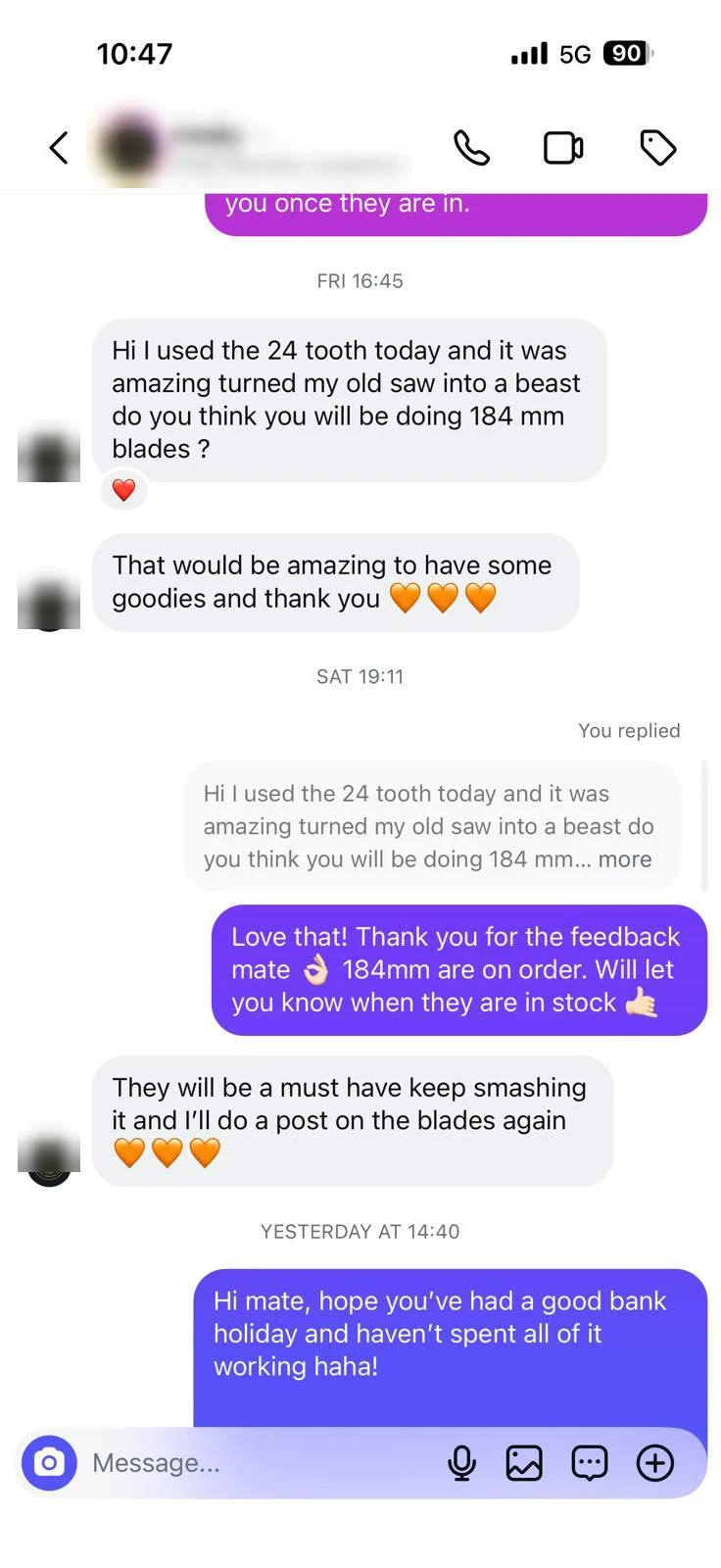
Most of the feedback a saw blade factory gets is a spec sheet with a tick next to it. Every so often something better comes back. This time it was a screenshot of an Instagram message from a carpenter in the UK, forwarded to us by the dealer who sold him the blade:
"Hi I used the 24 tooth today and it was amazing turned my old saw into a beast. Do you think you will be doing 184 mm blades?"
One message, and it tells you about the blade, about the dealer who picked it, and about where the product line went next. Here is the full story.
A dealer who still does the renovation work
Our partner is a UK company whose main business is renovation and fit-out. In 2024 they added a second line to it: supplying saw blades to the carpenters, renovators and small crews they already worked alongside.
That background shapes how they buy. Anyone who has spent years on site knows what a circular saw blade is up against on a Monday morning. Chipboard flooring. Damp framing timber. A plywood offcut with a screw hidden in it. A cordless saw that has already been dropped twice. This dealer does not sell blades off a spec sheet; they sell what they would put on their own saw. So the question they put to every potential saw blade supplier was a blunt one. Would we use this ourselves?
What a 6-1/2 inch blade has to do on a UK site
When the dealer first contacted Nakamura, the brief was short.
The blades had to fit the 165mm (6-1/2 inch) cordless circular saws and track saws that dominate UK job sites. The plate had to carry the dealer's own brand, not ours. They wanted two blades rather than ten, one for fast cutting and one for fine cutting, so a customer could get through most of a day's wood work with a pair. And the cut had to be clean enough, and the running smooth enough, that a professional would come back for a second one.
That last point is the one we hear least often and take most seriously. A blade that sells once is easy. A blade that a joiner reorders is the actual job.
Two blades, one plate
We worked through the options together and landed on two specifications that share the same diameter, kerf, plate thickness and bore. The only difference is tooth count, so their customers can choose by task without worrying about fit.
| Spec | 165 x 1.5 x 1.0 x 20 x 24T | 165 x 1.5 x 1.0 x 20 x 48T |
|---|---|---|
| Diameter | 165mm (6-1/2"), the common size for UK cordless circular saws and track saws | Same |
| Kerf | 1.5mm thin kerf | Same |
| Plate | 1.0mm | Same |
| Bore | 20mm | 20mm |
| Teeth | 24T, fast cutting and ripping | 48T, fine cutting and crosscutting |
| Typical work | Framing timber, structural sheet goods, first fix | Plywood, faced board, skirting and architrave, second fix |
| Plate design | Custom to the dealer's brand (design withheld at their request) | Same |
Why a 1.5mm kerf on a 1.0mm plate matters more in the UK than almost anywhere
UK sites run on batteries. 18V cordless circular saws and track saws do most of the cutting, and a corded saw is increasingly the exception. That changes what a good wood blade looks like.
A thin kerf saw blade removes less wood with every pass than the thicker kerfs many stock blades still carry. Less wood removed means less torque asked of the motor, less bogging down in thick stock, and more cuts per battery charge. The 1.0mm plate is what keeps the thin kerf honest. It stays stable at speed with low vibration, so the cut does not wander and the edge comes out clean.
That is the engineering behind "turned my old saw into a beast". The saw did not get any stronger. The blade simply stopped asking so much of it.
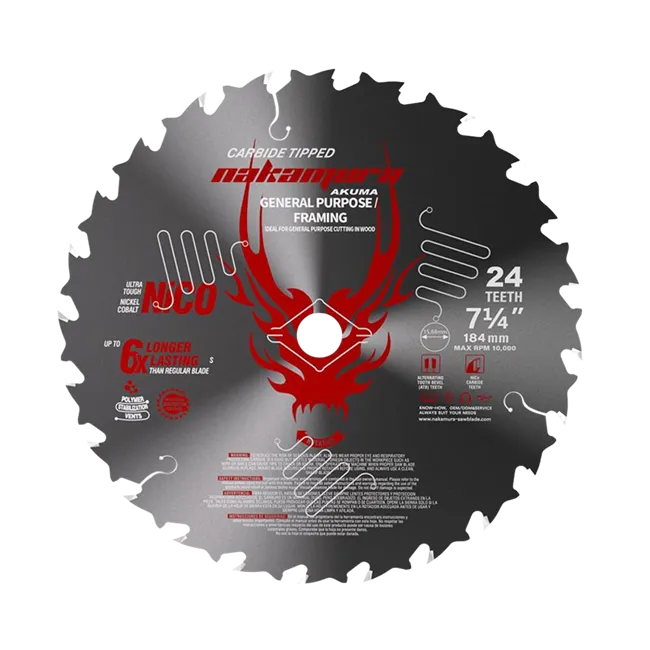
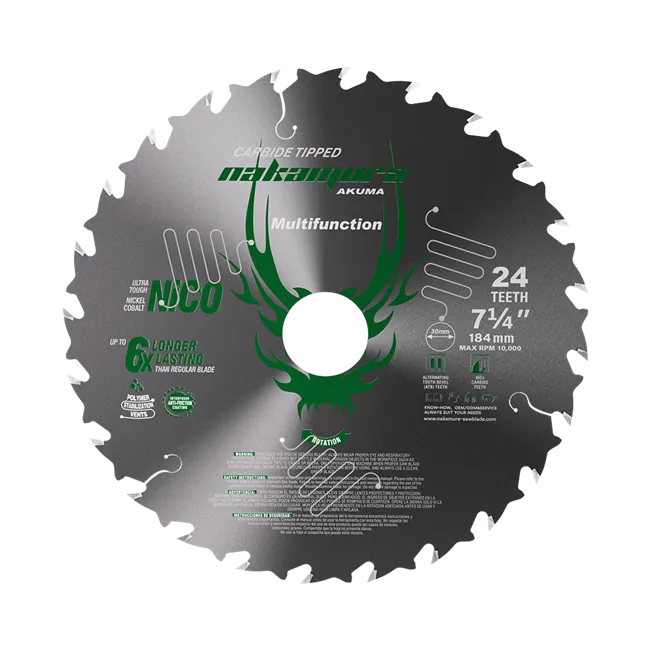
Akuma-Zero series (blades for cordless saws)
24T or 48T
The 24T is the one you reach for when speed matters more than finish. Large gullets clear chips quickly through framing timber and structural boards, and the saw keeps its pace. The 48T is for the cuts people will actually see: plywood, faced board, trim. More teeth, smaller bites, an edge that needs little or no sanding. The dealer sells them as a pair, and a lot of their customers buy them that way.
Their name on the plate, not ours
The plate design belongs to the dealer. They are building a brand of their own in the UK trade, and the blade carries it. Nakamura handled the proofing, printing and production; the artwork itself stays private at the customer's request.
For a distributor, this is where a product turns into an asset. Every good word that carpenter says about the 24T blade lands on the dealer's name. We think that is exactly how it should work.
Custom plate / private label service
The message from the job site
Our UK partner supplied blades to a local carpenter. After a day on the 24T, the carpenter messaged the dealer on Instagram, and the dealer passed the screenshot on to us. Avatar and account name have been blurred for privacy.
"Hi I used the 24 tooth today and it was amazing turned my old saw into a beast. Do you think you will be doing 184 mm blades?"
"They will be a must have. Keep smashing it and I'll do a post on the blades again."
Figure: Instagram conversation between the dealer and the end user (supplied by the dealer; identities blurred)
184mm: from a chat message to a purchase order
The question about 184mm did not sit in the chat window. The dealer placed an order with Nakamura for 184mm (7-1/4 inch) wood cutting blades and asked for samples first, to be proven on the end user's own saw before scaling up.
That is the order we like to see things done in. Sample on the real machine, then volume.
Cologne, March 2026
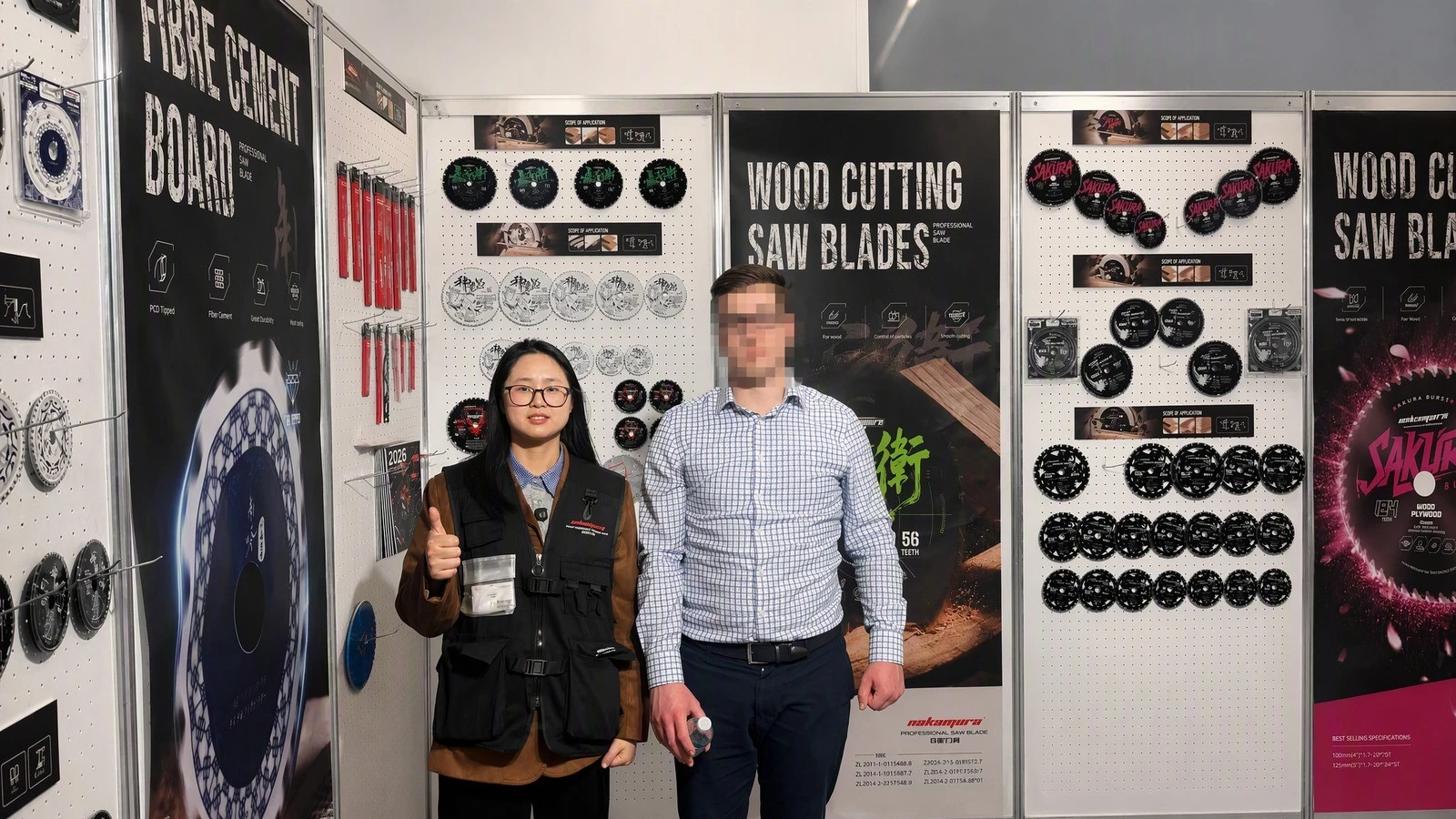
In March 2026 the dealer came to the Nakamura stand at the International Hardware Fair Cologne (Eisenwarenmesse) and asked, on the spot, what else we could match to the saws used in the UK market beyond the 165mm blades already on order. Which diameters, which tooth counts.
The business they started in 2024 is still built around the two 165mm custom-plate wood blades. It is now growing in two directions: new sizes requested directly by end users, with 184mm already supplied, and diamond blades for the tile and concrete cutting that comes up on renovation jobs.
For us this is the partnership model that works. The dealer stays close to the job site and brings back real requirements. We take care of specification, plate design and consistent quality at the factory.
Nakamura Factory and production process
If you supply blades to the trades
Here is how this project ran, and how we would suggest starting yours.
- Start with the saws your customers own. Diameter, bore, cordless or corded. For this dealer that was 165mm, 20mm bore, mostly battery tools, which pointed straight at a 1.5mm kerf on a 1.0mm plate.
- Pick a pair, not a catalogue. One fast blade and one fine blade cover most of a joiner's week. Add sizes when your customers ask for them, as this dealer did with 184mm.
- Put your own brand on the plate. The blade is your product. We print your design, and we keep it confidential.
- Test on a real saw before you order volume. Samples go to your customer's machine first. If it does not earn a reorder there, it is not ready.