


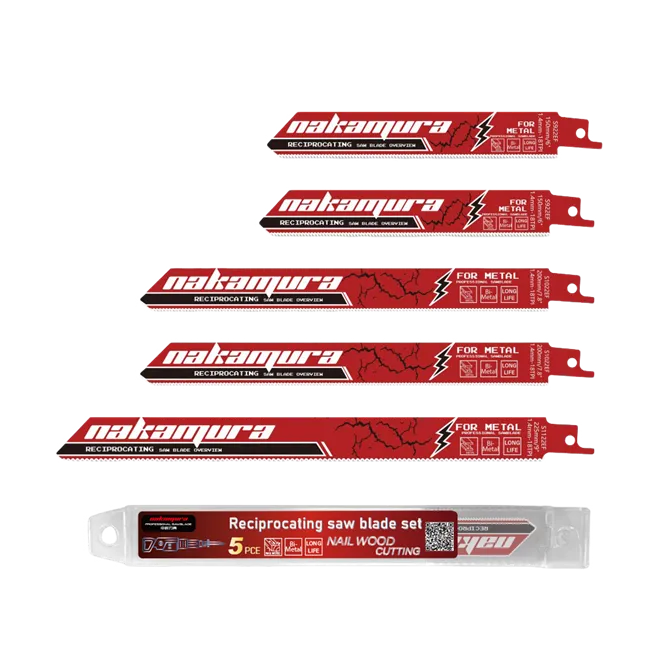

A reciprocating saw is a versatile power tool, but its cutting performance is strongly influenced by blade material, length, thickness, tooth geometry and TPI (teeth per inch). Selecting a blade that matches the material can improve cutting efficiency, stability and blade life.
In general, lower-TPI blades provide larger teeth and faster chip removal, making them suitable for wood, branches and certain demolition applications. Higher-TPI blades are generally better suited to metal and thinner materials. Bi-metal blades combine wear-resistant teeth with a tough blade body, making them suitable for applications involving wood, nail-embedded wood, metal pipes and mixed materials. Nakamura offers reciprocating saw blades for a range of wood, demolition and metal-cutting applications.
For different cutting requirements, Nakamura provides a range of professional reciprocating saw blade solutions.
9inch Demolition Reciprocating Saw Blades are designed for demolition applications involving nail-embedded wood, timber beams, pallets, metal pipes and mixed jobsite materials, making them suitable for demanding work where durability and impact resistance are important.
Arc Edge 6 TPI Reciprocating Saw Blade features an HCS blade body and a 6 TPI tooth configuration. Available in 7-, 9- and 12-inch lengths, it is designed for wet wood, softwood, hardwood, square timber, wooden framing and MDF.
For heavy-duty metal cutting, Thick Metal Reciprocating Saw Blades feature M42 bi-metal cobalt construction and are available in 8 TPI and 10 TPI configurations for applications such as thick steel plate, heavy-wall pipe, structural steel and heavy-duty metal demolition.


For professional users, blade selection should go beyond price. Matching the blade's TPI, material and dimensions to the material, thickness and working conditions can improve cutting stability, reduce unnecessary blade changes and help lower the overall cost per cut.