


1. Where Are Reciprocating Saw Blades Commonly Used?
-
Building Demolition and Renovation
Demolition jobs often involve timber, nail-embedded wood, plastic pipes, thin-wall metal tubes, angle steel, bolts, and mixed construction materials. These applications require a blade with strong impact resistance, good flexibility, and enough durability to reduce tooth damage, bending, and premature failure.
However, concrete, brick, ceramic, and masonry materials should not be treated as normal toothed-blade applications. For these hard and abrasive materials, carbide grit or diamond grit cutting tools are more suitable. Correct blade selection is essential for both cutting efficiency and operator safety.
-
Pipe Repair and Equipment Maintenance
In mechanical installation, plumbing, fire protection systems, and factory maintenance, working space is often limited. Angle grinders and circular saws may not fit into narrow areas, while a reciprocating saw can cut through a back-and-forth stroke motion, making it suitable for flush cuts, local openings, and confined-space cutting.
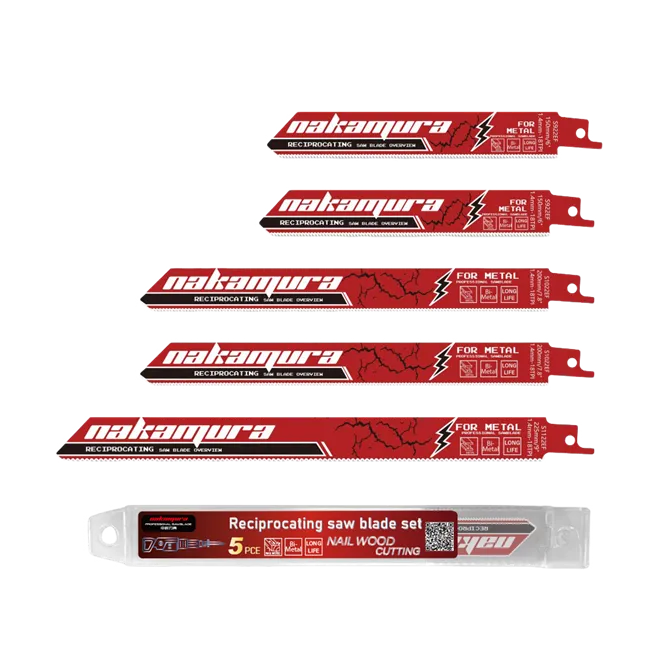
For metal pipes, thick-wall tubing, or stainless steel materials, bi-metal or cobalt high-speed steel teeth are recommended. For PVC, wood, and nail-embedded timber, users should select a demolition or multi-purpose blade with the proper TPI.
-
Emergency Repair and Fast Removal
In temporary repair, door and window removal, vehicle maintenance, and obstacle clearing, speed often matters more than a perfect finish. Reciprocating saw blades can start quickly, cut from edges or openings, and help workers create access in difficult conditions.
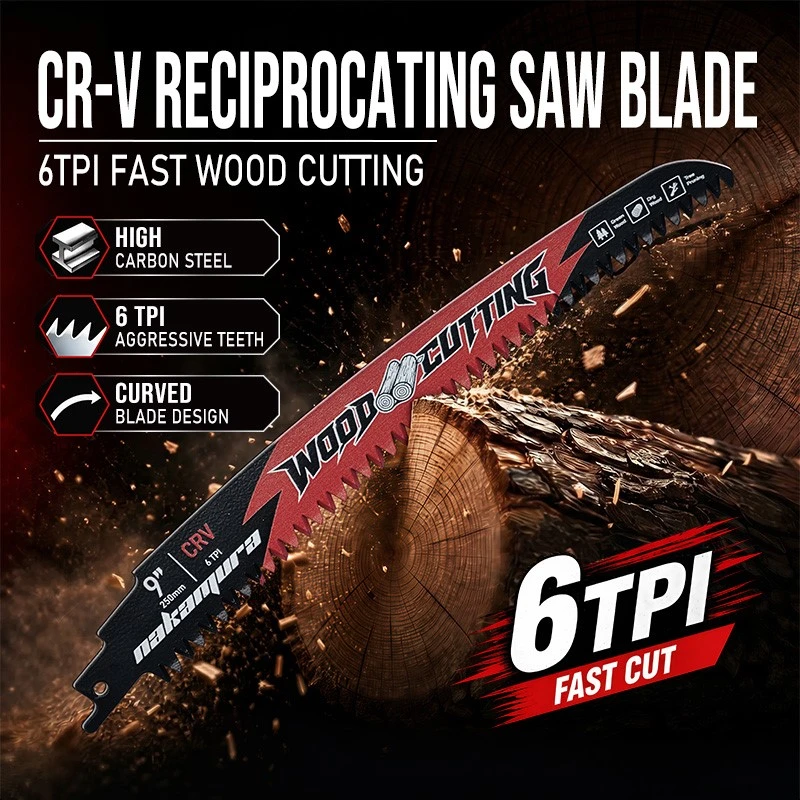
For example, 9inch Demolition Reciprocating Saw Blades are designed for heavy-duty demolition tasks, offering practical blade length, tooth configuration, and body strength for cutting wood, nail-embedded wood, and metal materials.
2. What Makes a Professional Reciprocating Saw Blade Reliable?
-
Material Matching
Different materials require different blade designs. Wood cutting needs fast chip removal. Metal cutting requires wear-resistant teeth and better heat resistance. Nail-embedded wood requires both toughness and impact resistance. For B2B purchasing and wholesale supply, building a blade range by material and application is more reliable than depending on a single "universal" blade.
-
Proper TPI Selection
TPI means teeth per inch. Low-TPI blades cut faster and are suitable for wood, branches, and rough demolition. High-TPI blades produce a more controlled cut and are better for metal pipes, sheet metal, and profiles. Variable TPI designs, such as 10-14TPI, are often used for mixed demolition jobs involving both wood and metal.
-
Bending and Breakage Resistance
In demolition work, blades often face angled cuts, flush cuts, impact cuts, and material binding. A professional reciprocating saw blade must balance body thickness, heat treatment, tooth hardness, and flexibility. It needs to be tough enough for heavy-duty work without becoming too brittle.
-
Smooth Chip Removal and Cutting Feel
A good blade is not only about aggressive speed. If chips are not cleared properly, the blade may overheat, bind, or wear down quickly. Proper tooth spacing, tooth geometry, and surface treatment help reduce friction and keep the cutting process more stable.

3. Why Choose Nakamura Reciprocating Saw Blades?
Nakamura offers reciprocating saw blades for demolition, metal cutting, wood cutting, and multi-material cutting, covering common sizes such as 6 inch, 9 inch, and 12 inch, with material options including BIM and carbide. For distributors, project buyers, and OEM/ODM customers, this product range is easier to build into a complete selling program rather than promoting only one model.
In demanding working conditions, Nakamura reciprocating saw blades provide value in three key ways:
- First, different tooth designs and TPI options help reduce efficiency loss caused by incorrect blade selection.
- Second, bi-metal construction combines tooth hardness with blade body flexibility, making the blade more suitable for frequent demolition use.
- Third, multiple sizes, packaging options, and OEM/ODM support make the product suitable for wholesalers, private-label brands, and tool set suppliers.
For applications such as wood, branches, PVC pipes, and nail-embedded timber, Wood Pruning Reciprocating Saw Blades can be a better choice to improve cutting efficiency and reduce unnecessary blade wear.
4. Jobsite Insight: Why Professionals Care About Blade Selection
A demolition contractor once summarized it clearly: "We used to cut wood, nails, and metal pipes with the same blade. It saved time at first, but the blade became dull quickly and the cutting speed dropped. After separating blades by material, using demolition blades for nail-embedded wood and metal blades for pipes, the work became faster and we changed blades less often."
This is the difference between casual use and professional use. The goal is not to make one blade do every job, but to choose the right blade according to material, thickness, and working conditions.
On demolition, repair, and emergency jobsites, reciprocating saw blades are used for heavy-duty, rough, and complex cutting tasks. A truly reliable blade must be sharp, but it also needs impact resistance, bending resistance, smooth chip removal, and stable performance across different materials.
Nakamura reciprocating saw blades focus on demolition, metal, wood, and multi-purpose cutting applications, providing practical cutting solutions for construction, pipe repair, tool wholesale, and OEM/ODM customers. With the right blade, complex cutting jobs become faster, safer, and more efficient.