

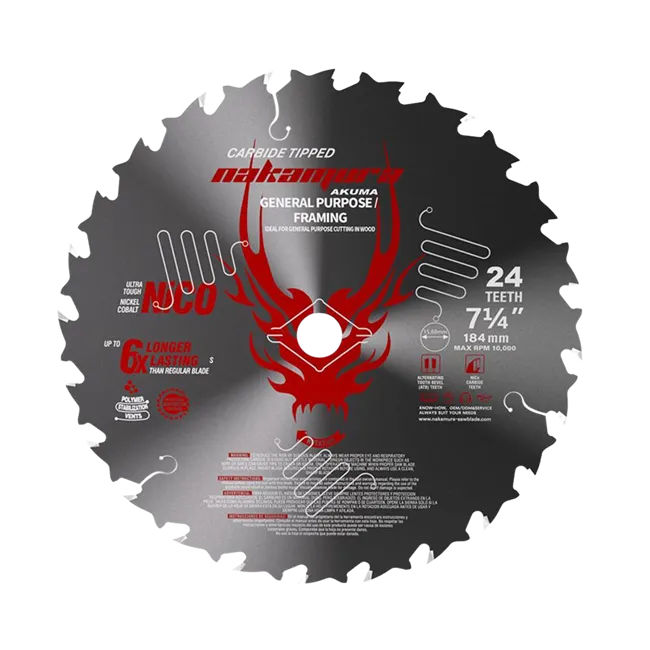
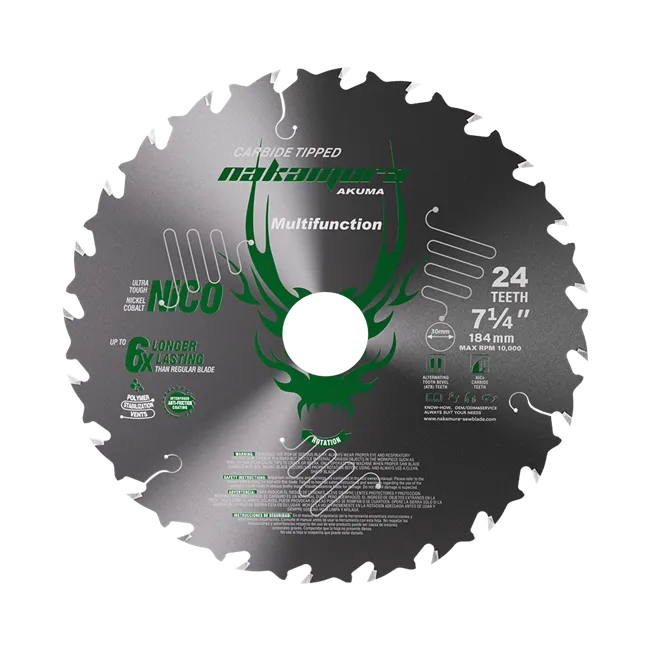



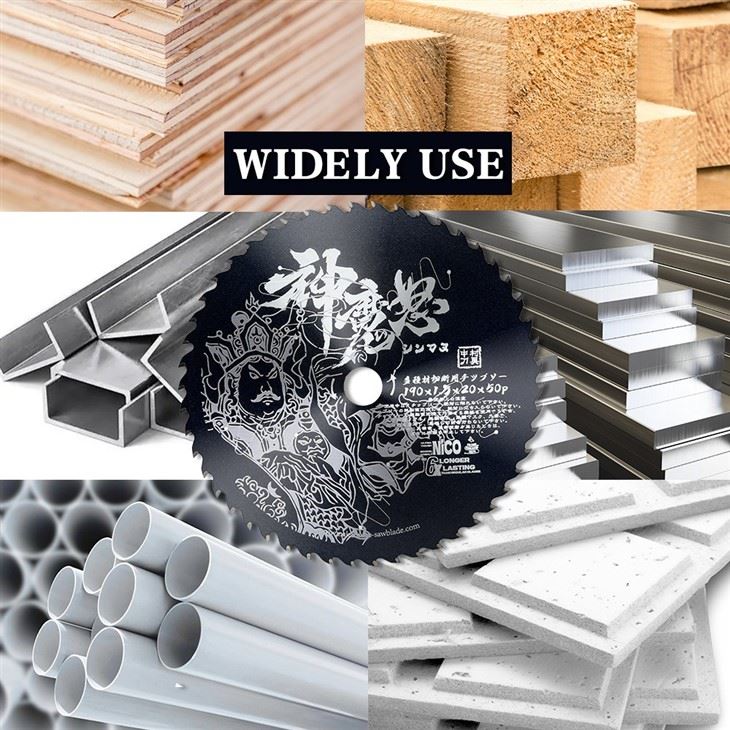
In the advanced manufacturing sector, processing composite materials-ranging from Wood-Plastic Composites (WPC) to dense synthetic resins-presents formidable thermodynamic and mechanical challenges. Unlike isotropic metals or natural timber, composites are engineered from multiple discrete substances. Cutting these materials often induces delamination, matrix melting, and accelerated tool wear. For industrial procurement officers and production engineers, specifying the precise Tungsten Carbide Tipped (TCT) saw blade is a critical operational mandate. When facilities require versatile sizing across mixed-density panels, deploying a highly calibrated Multipurpose Saw Blade 190mm provides the foundational mechanical stability needed to navigate varying material structures without inducing spindle harmonic vibration.
1. Material Specificity: Polymers and WPC Mechanics The primary challenge when cutting polymer-based composites (such as WPC or PVC laminates) is thermal accumulation. Excessive friction melts the resin matrix, leading to a fused, burr-ridden edge rather than a clean shear. To mitigate this, the blade's geometric parameters-specifically the rake angle and gullet capacity-must be optimized to reduce the chip load and evacuate heat rapidly. For precision sizing of high-polymer content composites, utilizing an application-specific 7 1 4 Circular Saw Blade For Plastic is mechanically required. Engineered with a modified zero or negative rake angle, this blade design prevents the teeth from aggressively grabbing the composite, eliminating hazardous kickback and ensuring a melt-free, structurally intact finish.
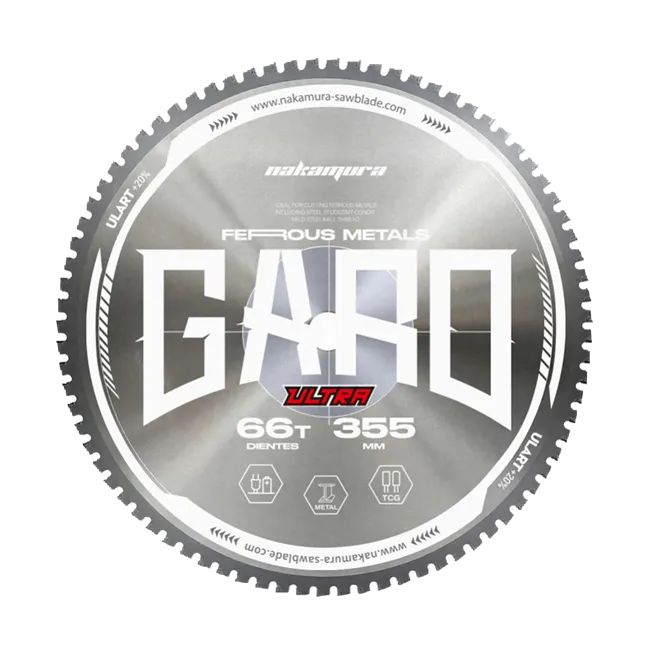
2. The Kinematics of the Triple Chip Grind (TCG) A cornerstone of composite and non-ferrous machining is the Triple Chip Grind (TCG) tooth profile. A common industrial misconception simplifies TCG geometry. In reality, it is a highly sophisticated alternating sequence: a higher trapezoidal (chamfered) tooth executes the initial central plunge, immediately followed by a lower flat "raker" tooth that clears the outer corners of the kerf. This sequential shearing distributes the cutting force, radically reducing impact shock and minimizing the risk of composite delamination. Due to the extreme density of certain laminates, manufacturers often repurpose non-ferrous tooling; for instance, deploying a 10 Inch Aluminum Cutting Saw Blade ensures access to this premium TCG geometry and the robust laser-welded carbide integrity necessary for slicing through rigid, abrasive composites.
3. The Boundary of Tungsten Carbide: Abrasive vs. Non-Abrasive Composites It is a critical engineering imperative to classify composite materials accurately before tooling selection. Premium tungsten carbide blades are exceptional for WPC, melamine, and standard laminates. However, aerospace and marine-grade composites-specifically Carbon Fiber Reinforced Polymers (CFRP) and Fiberglass-possess extreme abrasiveness. Processing carbon fiber or fiberglass with standard carbide blades will result in instantaneous metallurgical dulling. For these hyper-abrasive aerospace composites, processing facilities must transition from standard TCT tooling to Polycrystalline Diamond (PCD) saw blades to maintain continuous production cycles.
4. Operational Mandates: Dry Cutting and Dust Extraction A catastrophic operational error in composite machining is the introduction of liquid coolants or lubricants. Unlike metal fabrication, processing synthetic composites must be executed strictly as a dry-cutting operation. Introducing fluids creates a toxic, highly abrasive slurry that degrades the workpiece edges and permanently damages the machinery's moving components. Thermal management must be achieved solely through the optimization of the blade's peripheral velocity (RPM adjustment), the aerodynamic design of the blade's expansion slots, and the integration of high-velocity vacuum extraction systems to remove the heated dust immediately from the kerf.
Conclusion and B2B Procurement The optimization of saw blade geometry for composite materials is an exact science demanding strict adherence to mechanical and metallurgical principles. By aligning the tooth profile (TCG), rake angles, and specific carbide grades to the target composite, manufacturing facilities can drastically maximize their operational ROI and eliminate secondary finishing processes. As a premier manufacturer of advanced cutting technologies, we engineer our blades using state-of-the-art laser welding and computerized dynamic balancing. We invite global distributors and industrial fabrication partners to consult our technical engineering team for OEM-customized, application-specific cutting solutions.