


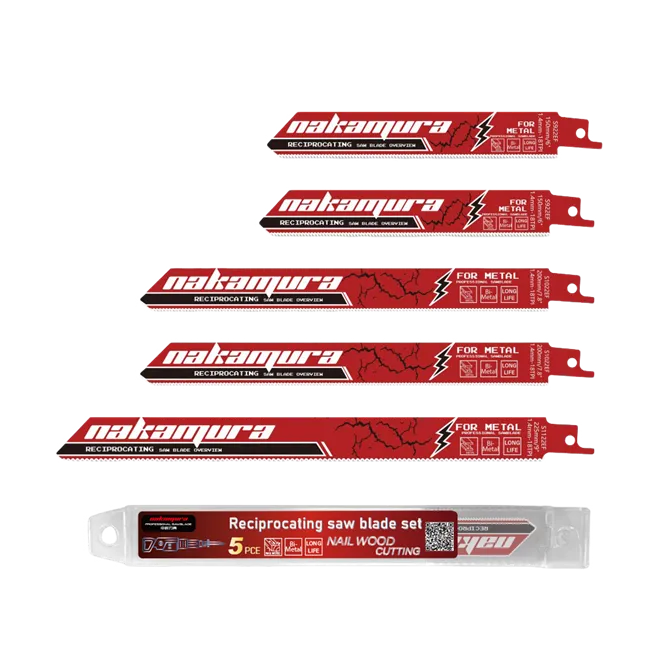
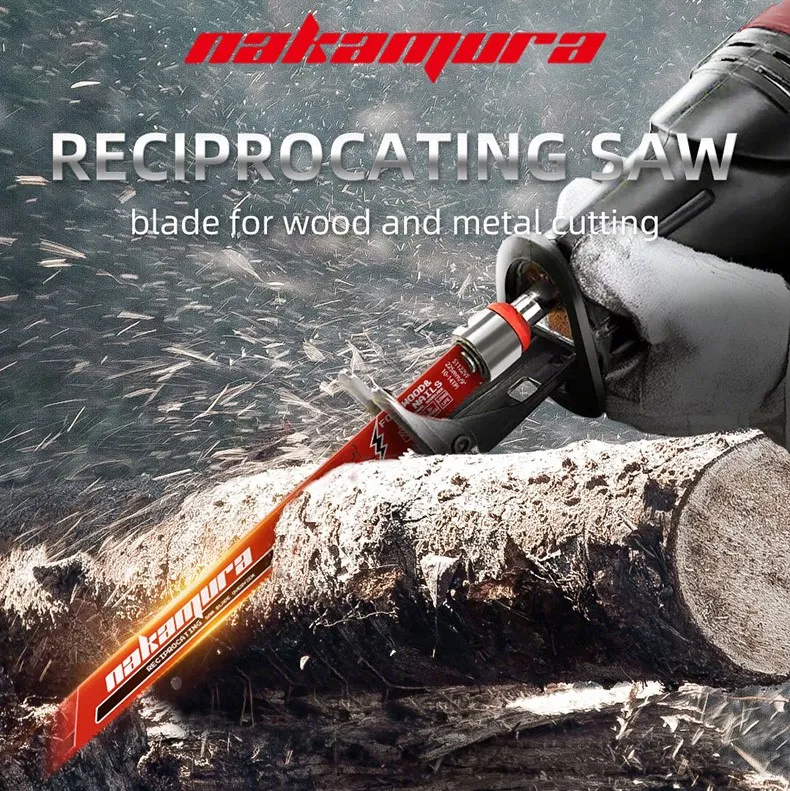
Reciprocating saws are among the most versatile tools available. Part of this versatility stems from the wide variety of blades designed to cut various materials. With the right blade, your "sawzall" can cut through wood, nails, fiberglass, tree branches, plaster, masonry, and metals (including aluminum, cast iron, steel, and even high-strength alloys). But how do you choose the right blade for the material you need to cut?
There are many blade characteristics to consider. Generally, these include blade material, length, width, thickness, and Teeth Per Inch (TPI). For specific types of cuts, you can also consider blade shape, tooth shape, kerf width, gullets, and tooth patterns. Despite the many choices, selecting the right reciprocating saw blade is easy once you master the basics.
1. Blade Material
(1) High-Carbon Steel (HCS)
Carbon steel blades are the least expensive and most common type. They are the softest of the blade materials and are usually more flexible, allowing them to bend without breaking in the right applications. However, this also makes them the least durable. They are suitable for cutting softwoods, particleboard, and plastics. When used on hardwoods, metals, and other hard materials, they will dull very quickly.
(2) High-Speed Steel (HSS)
High-speed steel blades undergo a tempering process that makes them more heat-resistant and durable than carbon steel blades. They last up to 5 times longer than HCS blades. This hardness makes them less flexible, meaning they are more prone to breaking if bent. However, it allows them to cut hardwoods, aluminum, and non-ferrous metals without excessive wear, dulling, or tooth breakage.
(3) Bi-Metal
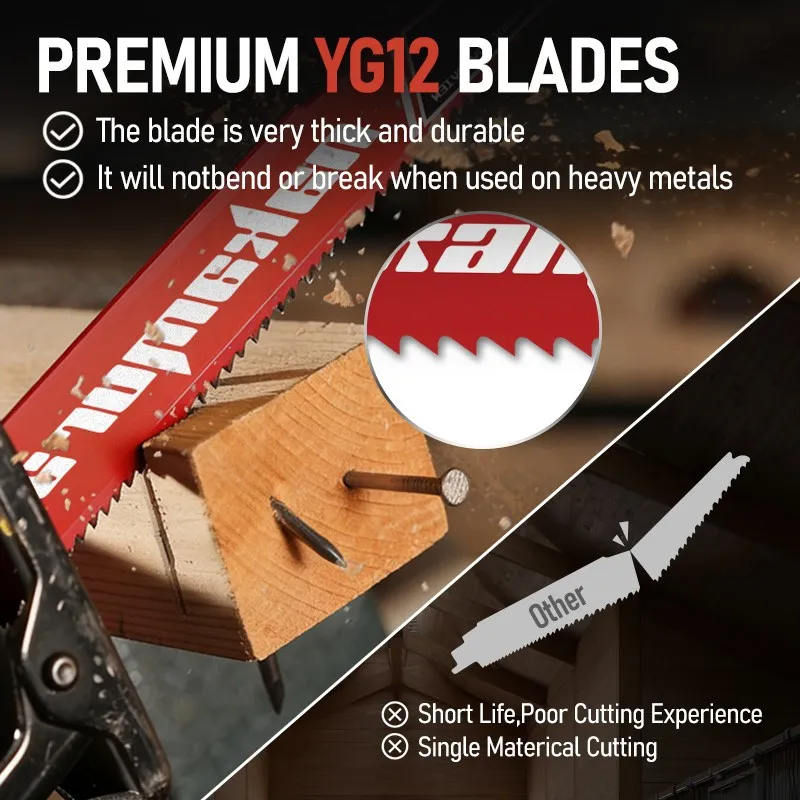
Bi-metal blades combine a high-carbon steel body (providing flexibility and break-resistance) with high-speed steel teeth (providing heat resistance, hardness, and durability). On average, bi-metal reciprocating saw blades last 10 times longer than carbon steel blades. While they cost slightly more than HSS or HCS blades, they offer the versatility and toughness required for more demanding applications. This makes them the most popular blade type among tradespeople, auto salvage yards, and other professionals who use reciprocating saws frequently or daily. We also recommend bi-metal blades for DIY projects and occasional users due to their durability and long lifespan.
Other bi-metal blades feature a cobalt-steel alloy cutting edge. This provides even greater heat resistance, wear resistance, and an overall longer blade life. These blades are suitable for a wide range of tasks, including demolition (wood with nails), vehicle dismantling, sheet metal and pipe cutting, as well as standard wood cutting.
(4) Carbide-Tipped
Carbide-tipped reciprocating saw blades are also bi-metal blades, but they feature a carbide (tungsten carbide or titanium carbide) tip on each tooth. These carbide materials are extremely hard, heat-resistant, and impact-resistant. They can deliver up to 20 times the cutting life of standard bi-metal blades. They can cut through thicker metal pieces, including cast iron, stainless steel, and high-strength alloys. This makes them ideal for cutting metals that would almost instantly destroy HCS, HSS, or traditional bi-metal blades, such as Grade 8 bolts and boron-reinforced automotive pillars.
(5) Carbide Grit
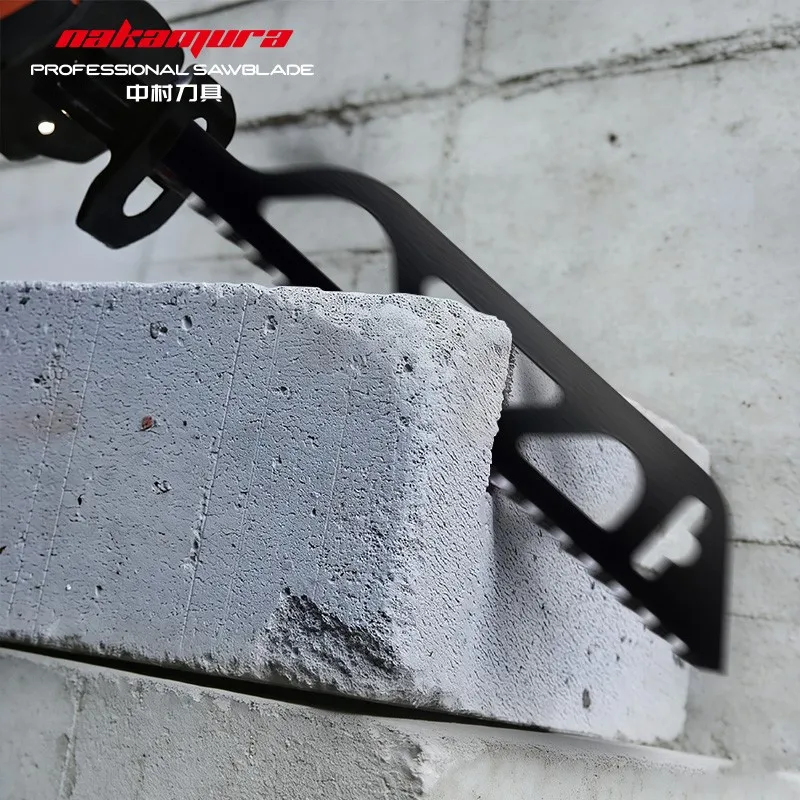
Carbide grit blades (typically tungsten carbide) do not have teeth like traditional reciprocating saw blades. Instead, they feature an abrasive grit edge designed for cutting dense materials such as ceramic tile, cement, brick, marble, other stone and masonry, harder metals (like cast iron), and fiberglass. The hardness of the carbide grit allows it to cut through these materials without damaging them or wearing out prematurely.
(6) Diamond
Diamond blades are also abrasive types but use industrial diamonds instead of carbide. These are the most expensive reciprocating saw blades. They are used to cut concrete, glass, fiberglass, and ceramics, as well as fiber cement, cast iron, and masonry. The hardness of diamonds and the fineness of the abrasive particles are necessary for cutting brittle materials (like glass, which would be shattered by a toothed blade) and very hard, dense materials (like concrete, which would destroy a toothed blade). Because of diamond's extreme hardness, diamond grit blades cut much faster and last 5 to 20 times longer than carbide grit blades.
Pro Tip:
When choosing a blade, remember this rule of thumb: The cutting edge of the blade must be harder than the material you are trying to cut.
2. Length
Reciprocating saw blades range in length from 3 inches to 12 inches. Standard lengths are 4, 6, 8, 9, and 12 inches, with 6-inch and 9-inch blades being the most commonly sold.
(1) Shorter blades are more rigid, allowing for more aggressive cutting. This rigidity helps you make straighter, squarer cuts, making them ideal for plunge cutting, copper pipes, and thinner metals.
(2) Longer blades are more flexible and can dissipate more heat due to their larger surface area. Tasks like demolition, tree pruning, vehicle dismantling, and rescue work require longer blades. This flexibility also allows you to bend the blade when flush cuts are needed.
The blade length you choose should always be slightly greater than the thickness of the material you are cutting. This reduces slipping and binding, giving you some freedom of movement. If a blade is too long, the tip can wobble, sometimes violently. This causes heavy vibration, slows down the cutting speed, and can ultimately ruin your workpiece and bend the blade.
Pro Tip:
Your blade length should always be 2 to 3 inches longer than the width of the material you are cutting.
3. Width and Shape
(1) Wider blades provide greater stability. They resist bending and vibration to deliver straighter, more aggressive cuts. The extra support makes wide blades ideal for heavy-duty applications such as demolition (wood with nails), auto dismantling, and fire and rescue. Widths from 3/4 inch to 1 inch are considered wide blades.
(2) Narrower blades offer greater flexibility for general-purpose or fine cutting. These usually fall in the 1/2-inch to 3/4-inch range.
(3) Very narrow blades (under 1/2 inch) are typically used for scroll cutting-making curved shapes and detailed work in wood, metal, and plastic.
The shape of the blade also matters. Sloped-shape blades are better for plunge cutting. Straight blades are used for edge cutting. Many blades feature a notched or sloped tip, or a semi-tapered back, allowing them to perform both tasks effectively.

4. Thickness
Standard reciprocating saw blade thicknesses include:
- 0.035 inches – Standard duty
- 0.042 inches – Medium heavy-duty
- 0.050 inches – Heavy-duty
- 0.062 inches – Ultra heavy-duty
Thicker blades are more durable and resist bending and vibration. They also allow for greater feed pressure during tougher jobs. Heavy-duty thicknesses of 0.050 inches to 0.062 inches are best for demolishing wood with nails, vehicle dismantling, fire and rescue, and cutting thicker or denser metals. Heavy-duty blades are rigid and have a wider kerf, so they are not recommended for applications requiring delicate cuts or flexibility.
General-purpose blades are usually 0.035 inches thick and work well for most applications. They are more flexible and provide faster cutting speeds. Because less material is used in manufacturing them, they also tend to cost less.
Pro Tip:
Longer blades bend more easily. If this is undesirable for your application, consider using a thicker blade for lengths of 6 inches or more.
5. Teeth Per Inch (TPI)
The TPI of reciprocating saw blades ranges from 3 to 24. The number of teeth per inch determines the cutting speed and the roughness of the cut surface.
- Lower TPI blades cut faster but leave rougher edges. Blades in the 3 to 11 TPI range are generally best for wood and demolition work. Tree pruning blades tend to be at the lower end, while demolition/nail-eating blades are typically around 8–11 TPI. General-purpose wood-cutting blades sit in the middle, usually around 6 TPI, and can also cut through nails.
- Higher TPI blades remove less material per stroke. Consequently, they cut slower but leave a much smoother edge. Blades with 12–18 TPI are commonly used for metal, denser materials, and finish cuts in wood. The 18–24 TPI range is almost exclusively used for metal cutting.
Pro Tip:
Always keep at least 3 teeth in contact with the material being cut. This reduces binding, keeps the cut smooth, and helps you maintain control over the cutting process.

Combination blades feature a variable TPI and are commonly used for wood and metal cutting as well as demolition work. Different areas of the blade have different TPIs, allowing the user to change the cutting dynamics depending on how they position the saw. For example, a 10/14 TPI blade has alternating 10 TPI and 14 TPI sections for cutting both wood and metal. A variable 14/18 TPI blade is designed to chew through metal.